
LaRue County VINE Coverage
Kentucky calls the service VINE, or Victim Information and Notification Everyday. The public interface is Kentucky VINELink. Kentucky sources say local jails and adult correctional facilities feed the system. That makes it relevant to a person recorded by LaRue County Detention Center and to a Kentucky state offender. One person may have both a local-jail record and a DOC record. Register on each applicable record because an alert tied to one reporting agency does not automatically follow a second record.
Coverage follows custody, not county residence. A local booking belongs to the jail feed. A state sentence belongs to Kentucky DOC, even when a state inmate is housed at the LaRue jail. A federal sentence must be checked with the Bureau of Prisons. Immigration custody uses the ICE locator. The Kentucky State Police registry is limited to people with a registration duty and is not a general release search.
The official Kentucky DOC VINE information explains coverage and PIN use. It also underscores why users should keep agency records in the confirmation chain.
Search One LaRue County Record
Start with enough information to distinguish the correct person, but avoid adding guesses that can hide the result. A partial name or known jail or DOC number is often the cleanest first query. Secondary details and the reporting agency matter when names are shared.
- Open VINELink and select Kentucky.
- Choose Find an Offender, then enter a partial name or offender ID.
- Compare the available identifiers and reporting agency before opening a record.
- Read custody status and location together. A transfer is not the same event as community release.
- If the result says the person is not in custody, note the displayed release date.
- Confirm the event through LaRue County Detention Center, a dated DOC release report, or the court and release record.
A phone search is also available at 800-511-1670. For a broader custody-specific path after the person disappears from a roster, use the LaRue County released-inmate search. It separates local, state, and federal records.
LaRue County VINELink Release Fields
VINELink describes the record supplied by a participating agency. Its fields should be read as a custody update, not as a full criminal case or sentence file.
| Field | What it means |
|---|---|
| Name or offender ID | Identifies the record selected for the search or alert. |
| Reporting agency | Shows whether the source is a jail or correctional agency. |
| Custody status | Reports the status currently supplied to VINE. |
| Location | Names the facility or agency associated with the record. |
| Release date | May appear when a matching person is reported out of custody. |
| Event options | Lists custody changes for which registration is offered. |
A court disposition is separate. A judge may authorize release before jail processing ends, while another agency hold may cause a transfer. For a Kentucky state offender, KOOL and DOC Daily Releases provide sentence and dated release context that VINE does not certify.
The VINELink search interface is shown below as the manifest’s successful Kentucky search capture.

The interface is the starting point for matching one record and choosing any offered notification options.
Register LaRue County Release Alerts
Registration begins only after the correct record is open. Search and registration are not the same action. A current search reads the status now supplied to VINE. Registration asks for later notice when the selected record changes.
- Choose Notify Me of Status Changes on the matched record.
- Select an offered phone, email, text, or in-app method.
- Enter the destination and complete the verification shown.
- For phone calls, create a four-digit PIN and keep it private.
- Save the confirmation and register separately for another valid jail or DOC record.
- Return to the record when contact information or alert needs change.
The PIN acknowledges a phone event and stops repeat calls. A switchboard is a poor choice if the person answering cannot enter it. Kentucky guidance permits more than one destination when the interface allows it. A notification may concern release, transfer, escape, return, or another custody event, so listen to the whole message.
The Kentucky VINE coverage page in the successful manifest capture explains state service and PIN guidance.
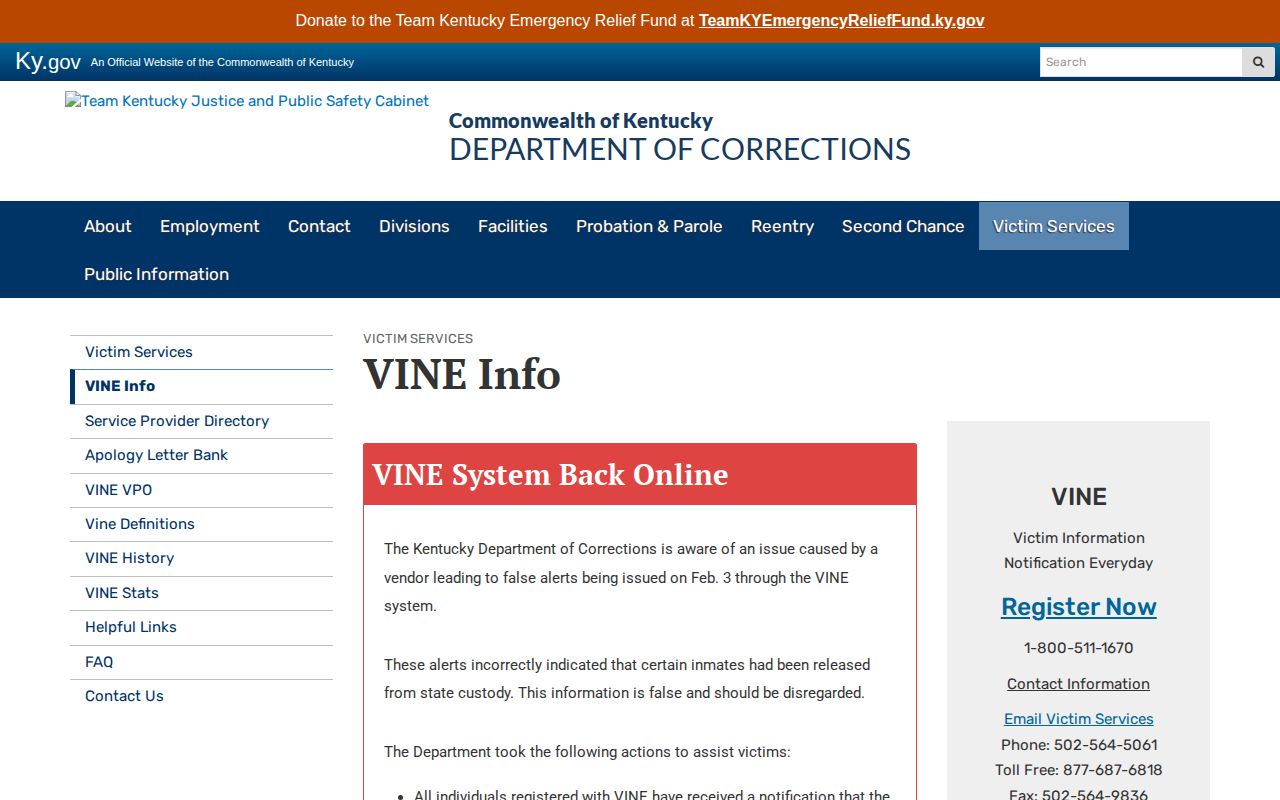
That state guidance complements the record-specific options presented by VINELink.
LaRue Jail VINE Timing
LaRue County Detention Center publishes unusually specific local guidance. Its local VINE page says the interface checks the jail booking system every 15 minutes. It supports a name or alias search and secondary details. The page also lists separate event types, including release, transfer, escape, return, unsupervised custody, and advance release notice.
This distinction matters. Leaving the LaRue jail can mean release to the community, but it can also mean transfer to Kentucky DOC, another jail, or another agency. The event label and reporting agency help explain the movement. They still do not replace the booking and release record.
- Release
- The reporting agency says its custody ended.
- Transfer
- Custody moved to another facility or agency.
- Discharge
- A sentence-ending event, not merely departure from one building.
- Detainer
- A hold or request from another authority that can affect where the person goes.
Note: A fifteen-minute feed check is a stated system interval, not a promise that every alert arrives within fifteen minutes.
Confirm LaRue County VINE Releases
VINE cannot guarantee advance notice, exact timing, or a complete historical record. A release can occur before an alert arrives. Data may lag, and duplicate records can exist. Kentucky DOC documented a 2026 vendor incident that sent false released alerts. That concrete event makes corroboration essential.
For a certified date, request the existing booking and release record. A court docket can explain the legal event, such as bond, dismissal, probation, or another order, but it does not alone prove the time physical release occurred. The jail or DOC execution record supplies that final fact.
Federal BOP custody is outside Kentucky VINE. A BOP result may say “Not in BOP custody” and show a release date. ICE has a current-custody locator, but an absent result is not historical proof of release or removal. Selecting the last confirmed custodian prevents a misleading conclusion.
A local confirmation request should identify the person and booking period, then ask for the existing record showing release date, time, authority, type, and any transfer destination. This wording lets the custodian locate a maintained record. It does not ask staff to decide whether the person is free from all forms of custody. If Kentucky DOC controlled the sentence, search KOOL by DOC number and compare the dated Daily Releases archive. Its report can identify the release type and releasing facility for a state offender, including some state inmates housed in a county jail.
VINE and the live jail roster answer different questions. The roster shows current public booking entries. VINE reports a supplied custody status and can send a later event notice. The release record documents the act ending one agency’s custody. A person absent from the roster could have been released, transferred, or picked up on another hold, so the two online checks still need the agency record when certainty matters.
Document a LaRue VINE Event
Keep the matched offender ID, reporting agency, alert time, and exact event wording when seeking confirmation. These details help LaRue staff or Kentucky DOC locate the correct record without relying on a shared name. If the event is a transfer, ask which agency received custody. If it is release, ask for the recorded release authority and time. For a court-linked event, compare the docket order with the later custody record. This evidence chain separates legal authorization, agency movement, and final discharge.
A screenshot can preserve what VINELink displayed, but it remains a snapshot of supplied data. The originating agency record is stronger. Note any mismatch and give the agency time of alert, name, offender number, and reporting source. A focused correction inquiry is easier to resolve than a broad claim that the system is wrong.
LaRue Release Alert Call Patterns
LaRue’s local VINE guidance gives added context for automated calls. For a jail release, Kentucky material describes calls repeating every 30 minutes for up to 24 hours until the recipient enters the four-digit PIN. A message left on voicemail does not confirm receipt. An unanswered or unconfirmed call can therefore lead to another attempt during the notification window. Calls may appear as unknown, so the recipient should listen for the event details before deciding what the notice means.
Planned release from a state institution may prompt an advance attempt. Other changes, including parole, a court event, time-credit action, or escape, may trigger only when the event occurs. These patterns are not promises. A court order can change, a scheduled date can move, and a data feed can reach VINE after the agency acts. The safest practice is to retain the alert details, enter the PIN only after hearing the message, and confirm the event through the responsible custodian.
Registration should also follow the record when two agencies are involved. A LaRue jail entry and a Kentucky DOC entry can coexist for the same person. The official state guidance advises registering for each applicable record. That step matters when a transfer closes the jail event while state custody continues. It also prevents a local release label from being mistaken for discharge from a Kentucky sentence.